The Revenge of Lard Ass Hogan
The Revenge of Lard Ass Hogan is a short story written by the adolescent Gordon Lachance and later published in Cavalier magazine in 1975. It is a grotesque, carnivalesque tale of a fat, bullied boy who exacts revenge on his entire town by inducing a chain-reaction vomiting epidemic during a pie-eating contest. The story functions within the larger narrative of The Body as a key artifact of Gordon's developing literary voice, a marker of his friendship with Chris Chambers, and a lens through which the adult narrator examines the relationship between memory, art, and the painful truths of childhood.
Origin and Narrative Context
The story is first told orally by a twelve-year-old Gordon to his friends Chris Chambers, Teddy Duchamp, and Vern Tessio as they rest during their hike along the GS&WM railroad tracks to find the body of Ray Brower. Chris, who has heard it before, prompts Gordon to tell it, calling it "really funny. Gross, but funny." The tale is a deliberate departure from the horror and war stories Gordon usually writes, particularly the Le Dio series that Teddy is obsessed with. The adult Gordon, reflecting on the story decades later, notes that it was the first piece of his fiction that felt like his own, the first that "might still be able to stand up, even with its props taken away." He also reveals that it was the first story he never showed to his parents, because it contained "too much Denny in it. Too much Castle Rock. And most of all, too much 1960."
Plot: The Great Gretna Pie-Eat
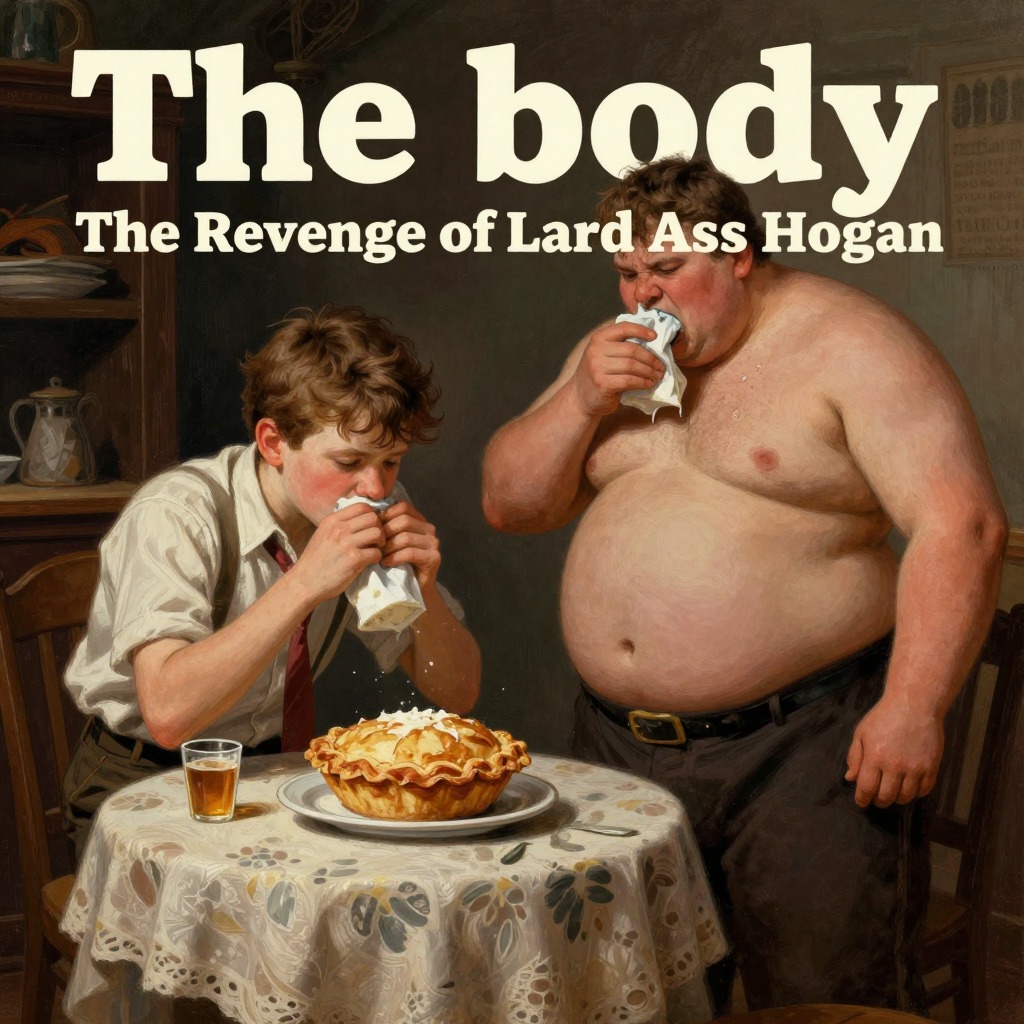
The story is set in the fictional town of Gretna, Maine, during its annual Pioneer Days celebration. The central character is David "Lard Ass" Hogan, a twelve-year-old boy who weighs one hundred and eighty pounds and is relentlessly tormented by his peers. The climax of Pioneer Days is the Great Gretna Pie-Eat of 1960, a contest with a five-dollar prize and a ten-minute time limit. The reigning champion is Bill Travis, a lanky mechanic who bets heavily on himself each year. Other contestants include Calvin Spier, the town's fattest man; Bob Cormier, a disc jockey; and John Wiggins, the school principal. Before the contest, Lard Ass drinks an entire bottle of castor oil. As he devours blueberry pies with superhuman speed, he deliberately tortures himself with grisly fantasies, imagining he is eating cowflops and diced-up woodchuck intestines. After finishing his fourth pie, he calls for a fifth. His stomach, overloaded with castor oil and pie, revolts. He vomits a torrent of blue-and-yellow puke onto Bill Travis. This triggers a chain reaction: Calvin Spier vomits on the mayor's wife, Bill Travis vomits on the crowd, the principal vomits into his own pie-plate, the mayor vomits on the microphone, and the contest's organizer, Sylvia Dodge, vomits on the mayor's back. The contagion spreads through the audience, creating a scene of total, grotesque chaos. Lard Ass, now at "the absolute apogee of his young life," calmly declares the contest a draw, walks home, and lies down on his bed.
Thematic Significance and Gordon's Commentary
The story is a darkly comic exploration of revenge, power, and the body's capacity for rebellion. It inverts the social order: the powerless, bullied child becomes the agent of a carnivalesque disruption that humiliates the entire adult community. The adult Gordon, however, is deeply critical of his own work. He calls it "pretty fucking melodramatic," "painfully derivative and painfully sophomoric," and notes its "attitude toward women goes beyond hostility and to a point which verges on actual ugliness." He identifies its stylistic debts to Hemingway and Faulkner and its thematic debt to the macho, working-class archetypes that would later populate Bruce Springsteen's songs. Yet he also defends it, finding within its "pseudo-toughness" and "pretensions" the "true face of Gordon Lachance lurking just behind the lines of print." The story, for him, represents a crucial step in his development as a writer: it was the first time he had "really used the place I knew and the things I felt in a piece of fiction," transforming troubling childhood memories—like the fear of his dead brother Denny in the closet—into a controlled artistic form. The story's ending, in which Lard Ass simply goes home, is deliberately anticlimactic. When his friends complain that the ending is "a gyp," Chris Chambers defends it, saying, "Life's a gyp, you know it? I mean, look at us." This exchange underscores the story's function as a mirror of the boys' own harsh reality, where there are no easy victories or heroic resolutions.
Connection to the Larger Narrative
The Revenge of Lard Ass Hogan is not merely a digression within The Body; it is a central artifact of Gordon's identity as a storyteller and a key to understanding his friendship with Chris. Chris is the story's most perceptive audience member, recognizing its quality when the others do not. He tells Gordon, "They come outta you just like bubbles out of soda-pop," and predicts, "You'll be a great writer someday, Gordie." This moment of validation is crucial for Gordon, who feels invisible in his own family. The story also serves as a point of contrast with the grim reality of the boys' quest. The pie-eating contest is a controlled, fictional chaos, while the discovery of Ray Brower's corpse is a real, traumatic encounter with death. The adult Gordon's later fantasy of finding Ray Brower's lost blueberry bucket—a symbol of the boy's lost life—echoes the way Lard Ass's story is a symbolic reclaiming of power. The story, like the bucket, is something the adult narrator can "hold" and "read," a tangible link to the past that helps him understand "which boy it was" that he used to be.